
The Problem with Traditional Email Management
Email is essential to modern work.
But managing a busy inbox manually can quickly become one of the most exhausting parts of the day.
Every message requires attention.
You need to read it, understand the context, decide what action is needed, and often write a response from scratch.
When that process is repeated dozens or hundreds of times, the mental cost adds up.
Manual email management creates constant context switching.
You move from a client question to an internal update, then to a scheduling request, then back to a long project conversation.
The result is fatigue, not just from writing emails, but from repeatedly deciding what to do next.
Why Fully Automated Email Fails
The promise of fully automated email is appealing.
Connect your inbox. Let AI respond. Move on.
But professional communication is rarely simple enough to automate completely.
The Loss of Personal Tone
An automated response may be technically correct while still sounding completely wrong.
It may be too formal, too casual, too enthusiastic, or simply unlike the way you normally communicate.
Your tone is part of your professional identity.
When AI sends messages without review, that personal voice can quickly become inconsistent.
The Risk of Hallucinations and Incorrect Context
AI systems can make mistakes.
They may misunderstand a conversation, miss an important detail, or generate information that is not accurate.
A response that sounds confident is not necessarily a response that is correct.
In professional communication, even a small error can create confusion or damage trust.
The Need for Human Nuance
Some messages require judgment that goes beyond the words on the screen.
A difficult client conversation.
A sensitive negotiation.
A carefully worded business decision.
These situations require understanding relationships, context, and consequences.
AI can help prepare the communication.
But human judgment should remain part of the process.
The Power of the Approve-First Workflow
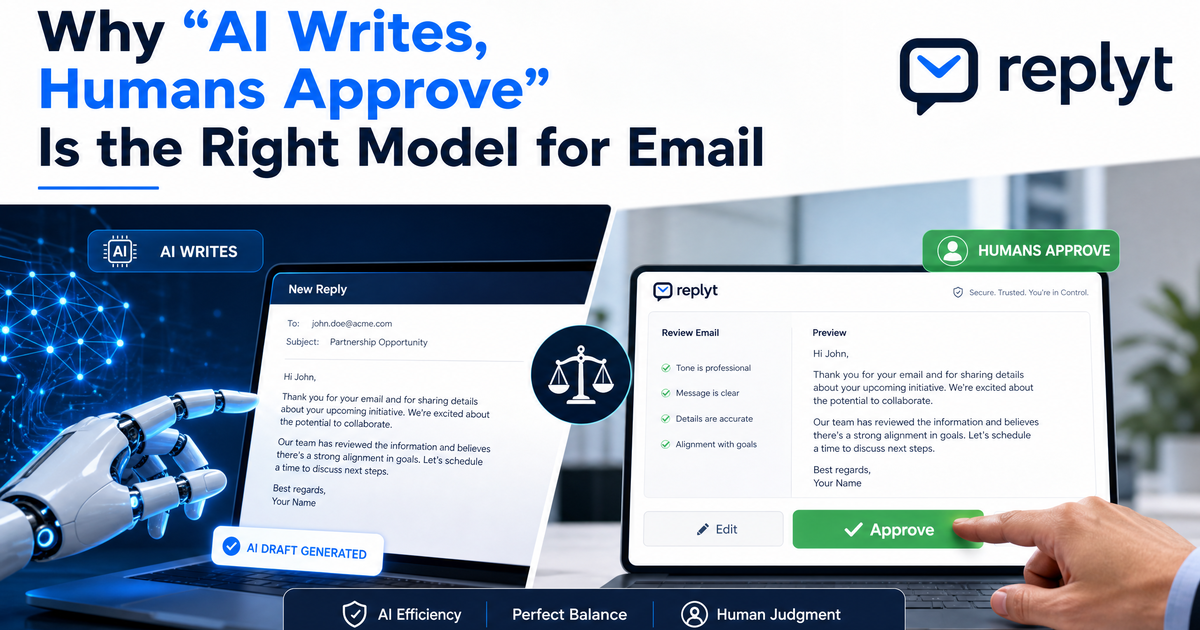
An approve-first workflow creates a better balance between AI efficiency and human control.
AI handles the heavy lifting:
Reviewing communication.
Summarizing conversations.
Identifying potential priorities.
Preparing draft responses.
You handle the final decision.
Before a message is sent, you can review the content, verify the details, adjust the tone, and make sure the response reflects what you actually want to say.
Then you can approve it or choose not to send it.
This approach helps eliminate repetitive work without removing the human from the communication process.
How replyt Streamlines Your Morning
replyt is designed to help you start your day with a clearer understanding of your inbox.
Instead of manually opening every unread message, you can begin with a morning briefing that helps surface:
Important conversations.
Tasks requiring attention.
Follow-ups.
Messages that may need a response.
For suitable conversations, replyt can also prepare AI-assisted draft responses.
The approve-first interface allows you to quickly review each draft and decide what happens next.
You can approve a response, edit it, or dismiss it.
The process is designed to be fast without sacrificing control.
AI prepares the work.
You make the final call.
Start Managing Your Inbox with replyt
Your inbox should not consume the time and mental energy you need for more important work.
With an approve-first AI workflow, you can reduce manual drafting, understand your inbox faster, and maintain control over every message you send.
replyt helps bring together morning inbox briefings, AI-assisted drafting, and human oversight in one streamlined workflow.
Sign up for replyt today and start building a more productive, focused email routine.